Industrial-Grade 3D Scanning — Blue Laser, IR, and LiDAR
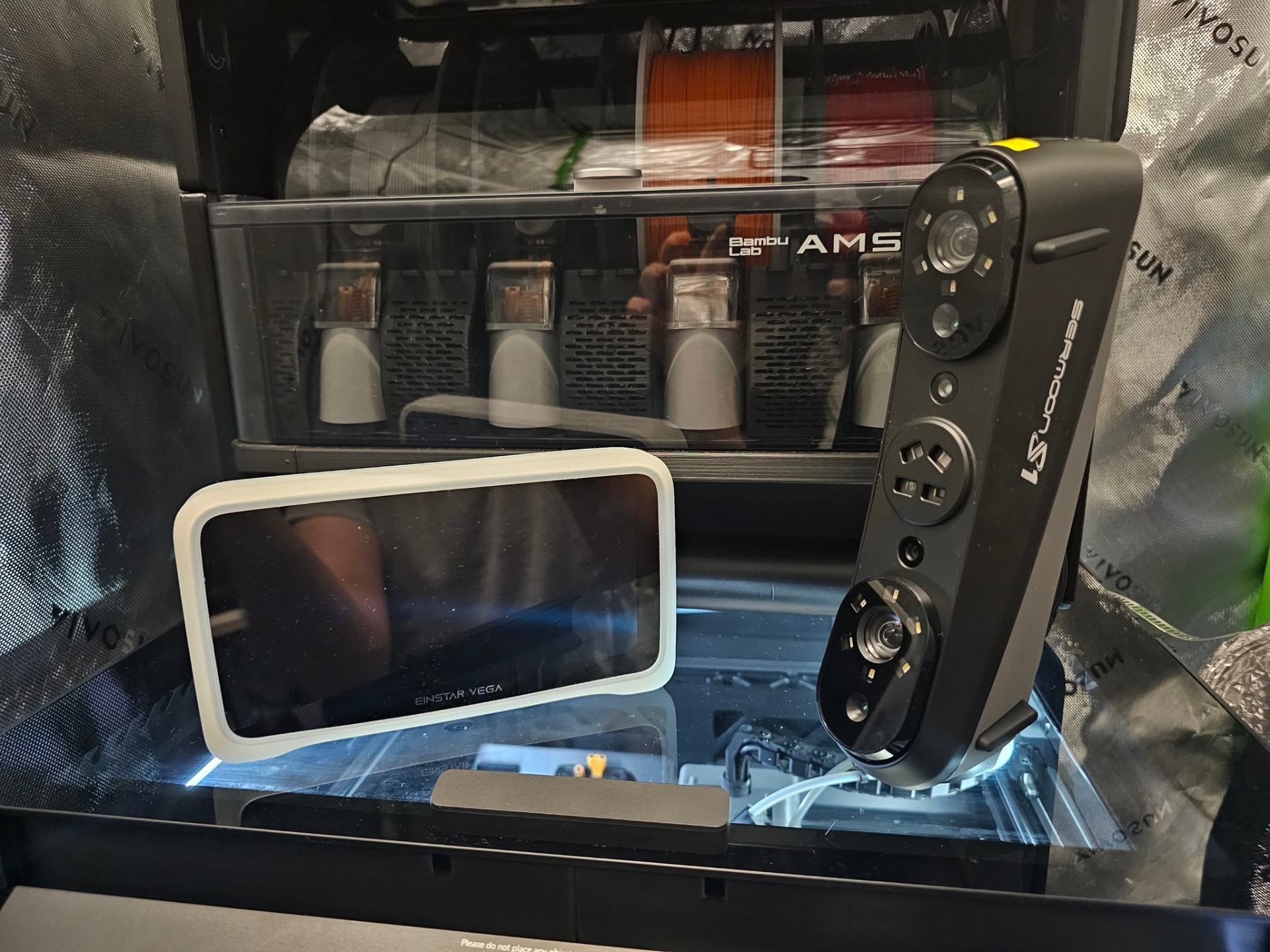
3D scanning captures the exact shape of a real object and turns it into a digital 3D model you can measure, redesign, reverse-engineer, or 3D print. If you have a broken part with no drawings, an antique car dashboard that has to be reproduced, or a machined component that needs an inspection report, a scan is where the project starts.
We run a full metrology stack — blue-laser structured light for small parts, infrared photogrammetry for organic surfaces, and LiDAR for rooms, vehicles, and buildings. Whichever technology fits your object best, we bring to the job. You never have to guess which one to ask for; we pick it based on size, material, and how accurate the result needs to be.
What each scanning technology is good at
Blue laser structured light is our precision workhorse. Multiple stripes of blue light are projected onto the object and cameras triangulate every point on the surface. Accuracy runs to about ±0.03 mm, features as small as 0.05 mm resolve cleanly, and shiny or dark surfaces scan without heavy prep. Perfect for mechanical parts, mold tools, medical devices, and anything that has to fit back into an assembly.
Infrared and photogrammetric scanning shines on larger and more organic subjects. Sculptures, human bodies, upholstered seats, hood scoops, hoods, and any big matte object where sub-tenth-of-a-millimeter accuracy is overkill. Accuracy in this mode is typically ±0.2 to ±0.5 mm depending on the subject.
LiDAR captures rooms, buildings, vehicles, and outdoor sites at scale. Time-of-flight pulses build a point cloud millions of points wide. Ideal for as-built documentation, film and game asset capture, crash reconstruction, and any project where the whole scene has to be modeled rather than a single object.
How a scanning job runs
You send us the part — either drop it off in DFW, ship it in, or schedule us on-site if the object cannot travel. We inspect it, apply any surface prep it needs (usually none for blue laser; occasional matting spray for high-gloss surfaces), and place tracking markers if the geometry requires them.
We scan from every angle needed to capture the full surface. The raw scans are aligned, meshed, and cleaned to produce a watertight polygon model — an STL, OBJ, or PLY you can view, measure, or 3D print immediately. If you also need editable CAD, our Reverse Engineering service picks up from this file.
Every job ends with a QC pass. We compare the final mesh back to the physical object and confirm accuracy before delivery. For inspection projects we also produce a color deviation map showing exactly where the manufactured part differs from the original CAD.
Deliverables and what to expect
Standard delivery is a watertight mesh (STL / OBJ / PLY). Optional extras include textured OBJ files, high-density point clouds for surveying software, a full inspection report with a color-map PDF, and cross-sections. Most single-object scans are delivered within 1–3 business days; on-site LiDAR captures depend on site access and scope.
Pricing starts around $150 per part for a straightforward mechanical scan and scales up with size, complexity, and the deliverable format. Same-day rushes are usually possible if the schedule allows — call ahead.
Materials
- • Metal machined parts
- • Plastic housings & consumer parts
- • Wood, foam, clay sculptures
- • Automotive body & interior panels
- • Rooms, buildings, job sites
- • Human bodies (busts, prosthetics fit)
- • Historical & museum artifacts
Capabilities
- • Blue-laser accuracy ±0.03 mm
- • IR photogrammetry ±0.2–0.5 mm
- • LiDAR for full rooms & vehicles
- • Point-cloud density > 10 M points
- • Watertight mesh output
- • Color-map inspection reports
- • On-site scanning available
Industries served
- • Automotive restoration
- • Aerospace inspection
- • Medical prosthetics
- • Manufacturing QA
- • Film, VFX & game production
- • Architecture & surveying
- • Heritage preservation
Frequently asked questions
How accurate is your 3D scanning?+
Blue-laser structured light is accurate to about ±0.03 mm on typical mechanical parts. IR and photogrammetry are ±0.2–0.5 mm on larger organic subjects. LiDAR accuracy depends on range and target.
Can you scan shiny or transparent parts?+
Yes. Our blue-laser system handles most shiny surfaces without prep. For very reflective or transparent parts we apply a temporary matting spray that wipes off cleanly after the scan.
How large a part can you scan?+
From a fingernail-sized bracket to full vehicles and building interiors. Small parts run on the blue-laser system; large objects and sites are captured with LiDAR.
Do I get a 3D-printable file?+
Yes. Our standard delivery is a watertight mesh (STL/OBJ) that goes straight to a 3D printer or into any 3D program.
Can you convert the scan into editable CAD?+
Yes — that is our Reverse Engineering service. We take the raw scan and rebuild it as a clean, parametric CAD model.
Do you travel to on-site jobs?+
Yes. We regularly scan on customer sites throughout the Dallas–Fort Worth area and travel nationwide for larger projects.
Explore our other services
Ready to start your industrial-grade 3d scanning - blue laser, ir, lidar project?
Send us your files, sketches, or a photo — we'll review and reply with a quote.
Request a Quote →