CAD & Engineering — 3D Design That Actually Manufactures
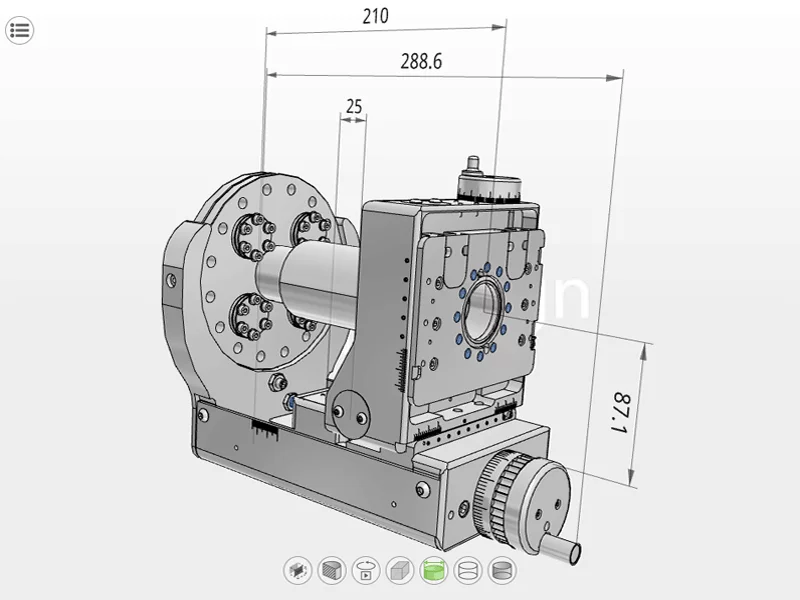
CAD stands for computer-aided design. In practice it means drawing your idea inside 3D software so a machine — a 3D printer, a CNC mill, an injection molder, a laser cutter — can produce it. A good CAD file is the difference between a part that works the first time and a part that ends up in a scrap bin.
This page is a plain-English guide to what our CAD & Engineering service does, how the process runs, and how we help even non-technical customers turn an idea into a manufacturable file. You do not need to speak CAD — you need to describe the problem you are solving. We handle the rest.
What we design
Custom brackets, mounts, and enclosures. Anything that has to hold something else in place — a phone in a car, a sensor on a robot, a battery in a drone. We design in parametric CAD so if the phone changes model or the sensor grows a millimeter, we can update the file in minutes instead of restarting.
Replacement and legacy parts. Send us a broken part or a scan and we will rebuild it as a clean CAD model — accurate, editable, and print- or machine-ready. If you would like the geometry redesigned to be stronger or lighter than the original, that is part of the job too.
New product concepts. If you are launching a product and need everything from initial sketches through DFM (design for manufacturing) and pilot tooling, we can be your engineering partner from day one. We work in SolidWorks and Fusion 360, and we deliver STEP, IGES, native, and drawing files.
Assemblies and mechanisms. Multi-part designs with real interfaces — hinges, snaps, threaded fasteners, tolerance stackups. We simulate motion, check clearances, and make sure the parts fit before you spend money on the first prototype.
How the design process runs
It starts with a conversation. Even a paragraph of text and one photo is enough to begin — what should the part do, where does it go, what is it attached to, how many will you need? We come back with clarifying questions and a fixed quote for the design work.
Concept and review. We build a first version of the model and send you renders. You look at it, tell us what to change, and we iterate. Most jobs need one or two review rounds. Because the file is parametric, changes cost hours instead of days.
Design for manufacturing. Once the shape is right, we tune it for the process you are using. FDM parts get thicker walls in the right spots, fillets to reduce stress, and orientation-friendly features. CNC parts get proper draft, generous internal radii, and standard tool sizes. Molded parts get uniform wall thickness and draft everywhere.
Deliverables and handoff. You receive the working file (STEP is the industry standard), a native file if you use SolidWorks or Fusion 360, plus 2D drawings if the part will be inspected or machined by a third party. If we are also making the parts, everything is already lined up for production.
Why design at a shop that also builds
Every one of our designers has spent thousands of hours watching parts come off the printers and mills. That means when we draw a feature we already know how it will behave in production — where supports have to go, where the tool cannot reach, where a wall will warp. Designs from an office-only CAD firm often look great and print badly. Ours are drawn by people who will also have to make the part.
We are also happy to work with your existing supply chain. If your machine shop is in another state and prefers a specific file format, drawing standard, or set of tolerances, tell us — we will match their conventions so the handoff is clean.
Materials
- • SolidWorks native (.sldprt / .sldasm)
- • Fusion 360 native (.f3d / .f3z)
- • STEP (industry standard exchange)
- • IGES for legacy CAM systems
- • STL / 3MF / OBJ for 3D printing
- • PDF 2D drawings (GD&T optional)
- • eDrawings for review
Capabilities
- • Parametric modeling
- • Multi-part assemblies
- • Tolerance & interference analysis
- • Design-for-additive & DFM
- • Mechanism & motion review
- • Print-ready & machine-ready files
- • Sheet-metal & weldment support
Industries served
- • Automotive & motorsport
- • Robotics & drones
- • Consumer electronics
- • Medical device
- • Industrial equipment
- • Startups & inventors
- • Home & DIY projects
Frequently asked questions
I don't have a technical background — can you still help me?+
Yes. A large share of our customers have never opened CAD software. Describe the problem, share photos or sketches, and we translate it into a manufacturable design.
How much does CAD work cost?+
Simple parts start around $95 per engineering hour. A typical bracket or replacement part is a few hours; full product designs are quoted by the project.
What file will I get?+
STEP for universal compatibility, plus native SolidWorks or Fusion 360 files if you use those tools, and 2D drawings when the part will be inspected or CNC-machined.
Do you keep my design confidential?+
Yes. We sign NDAs before any project starts if requested, and we never reuse or share customer designs.
Can you take a scanned part and turn it into editable CAD?+
Yes — that overlaps with our Reverse Engineering service. We rebuild the scanned geometry as a clean parametric model rather than a raw mesh.
Do you handle FEA or structural analysis?+
We handle everyday strength and clearance checks. For formal FEA reports we partner with a licensed analysis firm and manage the handoff.
Explore our other services
Ready to start your cad & engineering project?
Send us your files, sketches, or a photo — we'll review and reply with a quote.
Request a Quote →